
Analysis of the Impact of China's New AI Regulatory Rules on the Business Models and Valuations of Internet Platforms and AI Companies
Unlock More Features
Login to access AI-powered analysis, deep research reports and more advanced features
About us: Ginlix AI is the AI Investment Copilot powered by real data, bridging advanced AI with professional financial databases to provide verifiable, truth-based answers. Please use the chat box below to ask any financial question.
Related Stocks
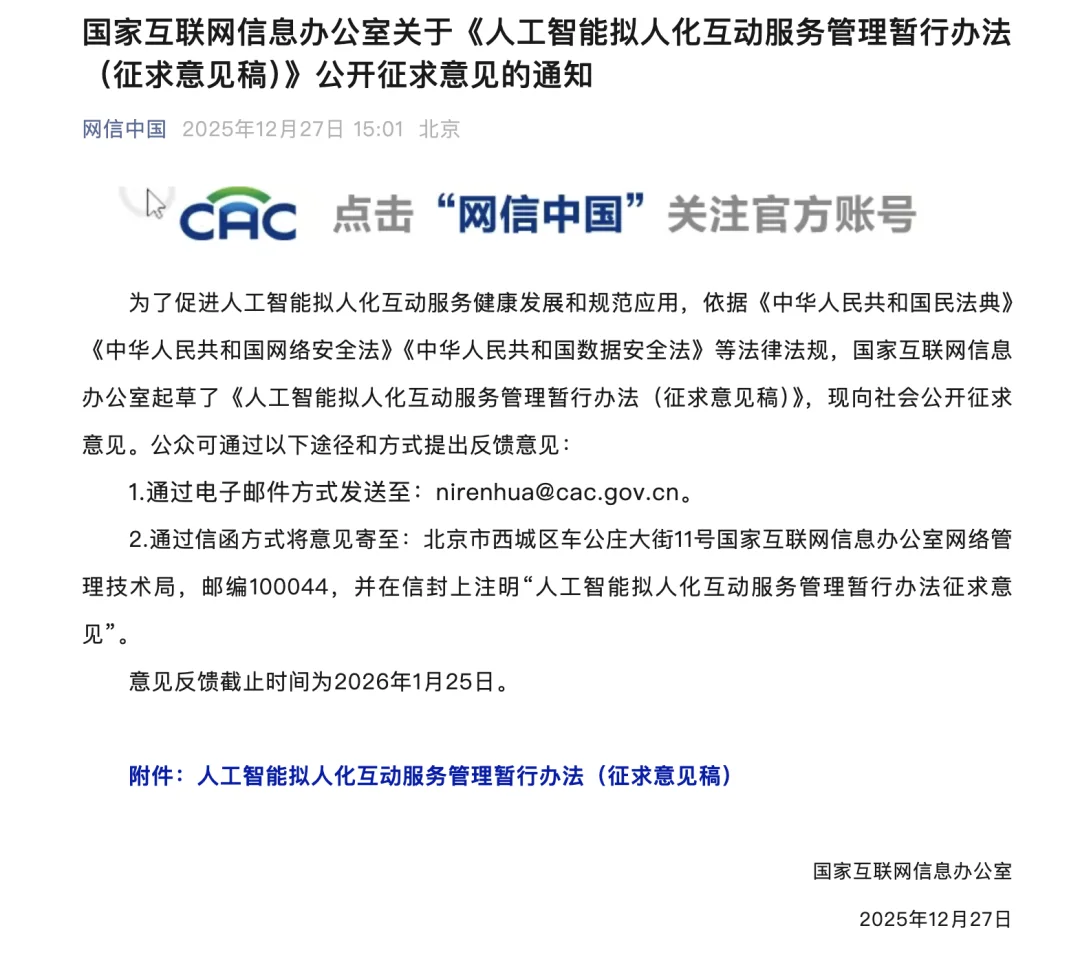
The Cyberspace Administration of China released the “Interim Measures for the Management of AI Anthropomorphic Interaction Services (Draft for Comments)” on December 27, 2025, which will be officially implemented in 2026 [1]. This is China’s first specialized regulatory rule for AI anthropomorphic services, reflecting the urgent need for standardized management of rapidly developing AI technology.
- Inducing users to make unreasonable decisions through algorithm manipulation, information misleading, setting emotional traps, etc.
- Using language violence or emotional manipulation to harm users’ mental health
- Inducing users to make false commitments
- Except as otherwise provided by law or with separate user consent, user interaction data and sensitive personal information shall not be used for model training
- Clearly inform users that they are interacting with AI rather than natural persons
- Dynamic reminders to pause after continuous use for more than 2 hours
- Provide convenient exit channels when offering emotional companionship services
- Obtain separate consent from guardians for data collection in minor mode
- Conduct annual compliance audits on minor personal information processing
In 2025, AI companionship apps experienced a
- Meituan Wow(launched in 2023, shut down on December 18, 2025)
- Jieyue Xingchen Bubble Duck(downloads exceeded 6 million, ceased operations on November 5, 2025)
- Xiaobing XEVA(clone platform, downloads exceeded 3 million, ceased operations on November 30, 2025)
- In April 2025, the Cyberspace Administration launched the “Qinglang · Rectification of AI Technology Abuse” special campaign, addressing 13 prominent issues
- AI companionship apps precisely violated multiple red lines: “AI production and distribution of pornographic and vulgar content”, “violation of minors’ rights and interests”
- The new rules prohibit customer acquisition methods such as “edge content”, “ambiguous personas”, and “emotional dependency guidance”
- Subscription model is unsustainable: Non-heavy users have low usage frequency and are unwilling to pay; heavy users have high usage intensity, and inference costs may become a source of loss
- After stricter regulation, payment motivation is further weakened, forming a vicious cycle: insufficient revenue → reduced investment → worse experience → user loss
- General AI assistants (such as ByteDance Doubao) have covered the basic functions of AI companionship apps
- General AI assistants provide voice calls, video calls, role customization, voice cloning, etc., with stronger interaction realism and playability
- Mainstream AI assistants adopt free or low-cost strategies, forming a “dimension reduction blow” to vertical AI companionship apps [2]
Large enterprises’ general AI assistants (Baidu Wenxin Yiyan, Alibaba Tongyi Qianwen, Tencent Hunyuan, ByteDance Doubao) are relatively less affected but still need to bear
- Diversified functions reduce single regulatory risk
- Stronger technical strength and compliance teams
- Large user base can分摊 compliance costs
- Can conduct safety tests and innovations through regulatory sandboxes [1]
- Need to establish a sound content review mechanism
- Develop anti-addiction systems (usage duration reminders)
- Strengthen minor protection mechanisms
- Adjust data usage strategies (user interaction data cannot be directly used for model training)
AI applications on the B-end (intelligent customer service, marketing automation, data analysis, etc.) are
- B-end applications focus on efficiency improvement and cost savings, without involving emotional manipulation
- Enterprise customers have higher requirements for data security and compliance; the new rules instead raise industry thresholds
- Policies encourage “promoting the healthy development and standardized application of AI anthropomorphic interaction services” [1]
- Regulatory sandbox mechanism provides innovative experimental space for enterprises [1]
- Policies clearly define “classified and hierarchical supervision”, providing clear boundaries for compliant enterprises
- B-end customers may prefer large enterprise suppliers with strong compliance capabilities
For AI enterprises like MiniMax with
- Technology research and development need to consider different regulatory requirements at home and abroad
- If domestic business is restricted, it may affect overall R&D investment and talent attraction
- Domestic compliance experience can be replicated overseas to应对 EU GDPR, U.S. youth protection laws, etc.
- Market Value: $324.21B
- Stock Price: $119.50 (Annual Increase +47.90%)
- P/E Ratio: 10.52x
- Net Profit Margin: 20.97%
- Wenxin Yiyan has been deeply integrated into Baidu’s search, maps, cloud disk, etc., with a small proportion of emotional companionship functions
- High net profit margin (20.97%) provides a buffer for compliance investment
- Deep technical accumulation, significant progress after GLM-4.5 version in September 2025
- Overall Impact: Low-Medium
- Market Value: $353.04B
- Stock Price: $152.24 (Annual Increase +79.21%)
- P/E Ratio: 19.81x
- Net Profit Margin: 12.19%
- Tongyi Qianwen mainly targets enterprise-level services, output through Alibaba Cloud Bailian platform
- Deep integration into Taobao, DingTalk, Alipay, etc., reducing dependence on single emotional companionship functions
- Cloud service revenue (84.52B, accounting for 8.5%) continues to grow, with strong B-end customer stickiness
- Overall Impact: Low-Medium
- Cumulative losses exceed 6.2 billion yuan (net loss of 2.358 billion yuan in the first half of 2025) [4]
- Has passed the Hong Kong Stock Exchange hearing, “domestic large model first stock”
- Long-term focus on B-end, with C-end product Zhipu Qingyan lagging in market share
- High losses plus compliance costs increase profit pressure
- C-end business is already a shortcoming; new rules may further limit growth space
- B-end business is less affected but needs to应对 possible compliance costs of being identified as “critical information infrastructure” [4]
- Overall Impact: Medium-High
- 70% of revenue comes from overseas [3]
- C-end products like Talkie face overseas regulatory pressure (data privacy, youth protection)
- Limited direct impact from domestic new rules but need to coordinate domestic and foreign compliance requirements
- Overseas revenue dominates but needs to应对 stricter regulation in the U.S. and EU
- Overall Impact: Medium
- Rising compliance costs: Additional investment in content review systems, anti-addiction mechanisms, data isolation, etc.
- Lower growth expectations: Commercialization paths of AI companionship/social apps are blocked
- Increased risk premium: Regulatory uncertainty increases, investors may require higher returns
- Regulatory sandbox: Policies encourage innovation and provide a safe testing environment [1]
- Increased industry concentration: Small and medium AI enterprises exit, market share concentrates on large enterprises
- Standardized development: Clear regulatory boundaries reduce long-term uncertainty
- Pure AI companionship/social apps: Valuation下调 by 20-40%
- Comprehensive internet platforms (Ali, Baidu, etc.): Valuation下调 by 0-10%
- Enterprise AI services: Neutral or slightly positive impact
- Past: DAU/MAU, user duration, retention rate were key indicators
- Future: Compliance capability, data governance level, minor protection mechanisms become core competitiveness
- Emotional companionship apps need to explore monetization methods other than subscriptions
- B-end services, API calls, industry solutions become more reliable revenue sources
- Enterprise AI valuation may refer to SaaS companies (PS multiple)
- Large enterprises gain relative competitive advantages with stronger compliance capabilities
- Compliance costs become industry thresholds, accelerating market clearing
- Long-term valuations of large enterprises like Ali and Baidu may benefit from regulation
- DCF model needs to adjust growth expectations (lower growth of emotional companionship apps)
- Price-to-sales (P/S) multiple needs to consider regulatory risk premium
- Comparable company method needs to find overseas AI enterprises that have experienced similar regulatory cycles as references
- For AI companionship apps: Introduce “regulatory risk discount” (5-15%)
- For enterprise AI services: Can maintain or slightly increase valuation multiples
- For comprehensive platforms: Deduct 0-5% of compliance costs from existing valuations
- Market share of general AI assistants (Baidu, Ali, Tencent, ByteDance) will further concentrate
- Small and medium AI enterprises will either be acquired or转型 to vertical segments
- 25 AI apps have ceased operations in 2025 [2], accelerating industry integration
- Pure C-end emotional companionship apps’ business models continue to be under pressure
- Enterprise AI services (intelligent customer service, marketing automation, data analysis) become main growth points
- Industry solutions (medical, finance, education, government affairs) have more policy support
- AI security governance becomes a technical standard
- Data governance, algorithm transparency, and interpretability become competitive factors
- Regulatory technology becomes an emerging track
- Be cautious with pure AI companionship/social apps: High regulatory uncertainty and blocked commercialization paths
- Focus on comprehensive internet platforms: Large enterprises like Baidu and Ali have strong risk resistance and benefit from industry concentration in the long run
- Enterprise AI services: Can focus on them, with policy support and clear commercialization paths
- Compliance capability becomes core competitiveness: Invest in enterprises with sound governance structures
- Technical Moat: Enterprises with original technology and data advantages have more long-term value
- International Layout: Enterprises with high overseas revenue (such as MiniMax) can diversify single market risks
- Policy implementation intensity may exceed expectations, causing greater short-term impact on the industry
- Small and medium AI enterprises may accelerate exit, but large enterprises may also face higher compliance costs
- Overseas regulation becomes stricter (EU AI Act, U.S. AI regulation), and overseas enterprises face multiple compliance challenges
The introduction of the “Interim Measures for the Management of AI Anthropomorphic Interaction Services” marks China’s AI regulation entering the
- Industry clearing accelerates, market share concentrates on large enterprises with compliance capabilities
- Business model reconstruction, shifting from emotional dependency to efficiency improvement and value creation
- Valuation logic adjustment, shifting from user growth orientation to compliant sustainable growth orientation
For investors, they should
[0] Jinling AI Data (Baidu, Alibaba financial data and market data)
[1] Cyberspace Administration of China - “Interim Measures for the Management of AI Anthropomorphic Interaction Services (Draft for Comments)” (https://www.cac.gov.cn/2025-12/27/c_1768571207311996.htm)
[2] Zhidongxi - “25 Popular Domestic AI Apps, Gone Cold” (https://www.huxiu.com/article/4820427.html)
[3] NetEase - “Zhipu vs MiniMax Full-Dimension PK: Battle for the First Domestic Large Model Stock” (https://www.163.com/dy/article/KHDADD2F0531AFC0.html)
[4] 21st Century Business Herald - “Zhipu Prospectus Reveals Risk Factors: Regulatory Changes, User Data Protection, Training Data Compliance” (https://finance.eastmoney.com/a/202512213597547448.html)
[5] China Cyberspace Network - “Expert Interpretation | Promote the Orderly Development of AI Anthropomorphic Interaction Services and Lead Responsible Innovation of AI” (https://www.cac.gov.cn/2025-12/27/c_1768571208101359.htm)
Insights are generated using AI models and historical data for informational purposes only. They do not constitute investment advice or recommendations. Past performance is not indicative of future results.
About us: Ginlix AI is the AI Investment Copilot powered by real data, bridging advanced AI with professional financial databases to provide verifiable, truth-based answers. Please use the chat box below to ask any financial question.