
Analysis Report on Deficiencies in Caitong Securities' Compliance and Risk Control System
Unlock More Features
Login to access AI-powered analysis, deep research reports and more advanced features
About us: Ginlix AI is the AI Investment Copilot powered by real data, bridging advanced AI with professional financial databases to provide verifiable, truth-based answers. Please use the chat box below to ask any financial question.
Related Stocks
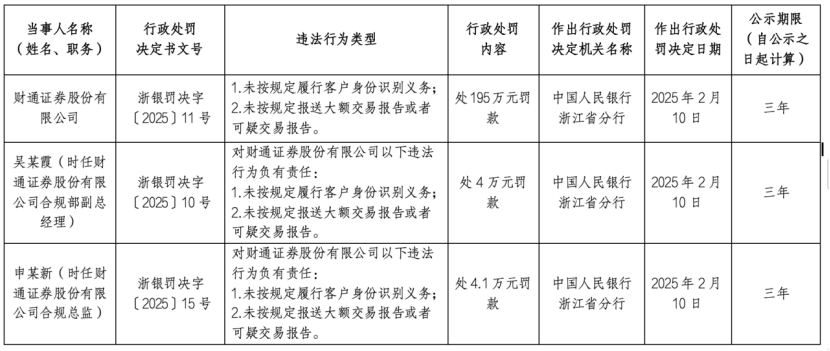
According to public information, Caitong Securities Co., Ltd. (stock code: 601108.SS) received a total of 5 regulatory fines in 2025, involving multiple areas such as over-the-counter (OTC) derivatives business, investment banking business, overseas subsidiary management, anti-money laundering compliance, and employee behavior management [1][2][3]. From the perspective of core regulatory indicators like net capital/risk coverage ratio, these penalties reflect systemic deficiencies in Caitong Securities’ compliance and risk control system.
| Penalty Date | Regulatory Authority | Violation Type | Key Issues | Relevant Indicator Links |
|---|---|---|---|---|
| Feb 17, 2025 | People’s Bank of China Zhejiang Branch | Anti-money laundering fine of 1.95 million yuan | Failed to fulfill customer identification obligations as required, failed to submit large-value transaction reports or suspicious transaction reports | Risk coverage ratio, compliance risk management |
| Sep 26, 2025 | Zhejiang Securities Regulatory Bureau | Warning letter for overseas subsidiaries | Failed to establish a tracking system for decision-making matters of overseas subsidiaries, failed to improve risk control mechanisms, directors’ qualifications did not meet requirements | Net capital/risk capital reserve, cross-border risk control |
| Nov 6, 2025 | Shanghai Stock Exchange | Written warning for investment banking business | Failed to exercise due diligence in private placement bond projects, failed to fully verify the use of raised funds | Risk capital reserve, internal control |
| Nov 7, 2025 | Zhejiang Securities Regulatory Bureau | Order to rectify OTC derivatives business | Inadequate underlying asset management mechanism, insufficient review of investor qualifications, improper permission management of management systems | Net capital/risk coverage ratio, market risk management |
| Dec 2025 | Jiangsu Securities Regulatory Bureau | Warning letter for employee violations | Misleading customers via WeChat groups, insufficient risk disclosure, operating customer accounts | Employee behavior management, compliance culture |
From the distribution of the above fines, Caitong Securities’ compliance issues cover multiple levels including front-end business (OTC derivatives, investment banking), middle-office management (internal control, risk management), and back-end support (anti-money laundering, information technology systems), showing a “comprehensive” characteristic.
According to the “Measures for the Management of Risk Control Indicators of Securities Companies”, securities companies must meet the following core regulatory requirements:
- Incomplete system coverage:From OTC derivatives to overseas subsidiaries, there is a lack of a unified risk identification, measurement, and monitoring framework
- Insufficient implementation:Even if systems are established, there are obvious loopholes in implementation aspects such as permission management and qualification review
- Lagging monitoring mechanism:No dynamic monitoring and timely early warning mechanism for business risks has been established
- Lack of dynamic adjustment mechanism for linked underlying assets, leading to inability to respond timely when risk characteristics of underlying assets change
- Investor suitability management is a formality, and annual review work is insufficient
- Permission management of business management systems is chaotic, and password management has security risks
- Incomplete project verification procedures, blind spots in key information review
- Lax verification of the use of raised funds, affecting the accuracy of application documents
- Insufficient forward shift of quality control checkpoints, relying on post-event regulatory discovery
- No tracking system for the implementation of decision-making matters covering overseas subsidiaries has been established
- Risk control mechanism for overseas subsidiaries is inadequate
- Lax review of directors’ qualifications
- Customer identification system is not properly implemented
- Large-value transaction and suspicious transaction reporting mechanisms are incomplete
- This is the first penalty for a securities firm since the newly revised Anti-Money Laundering Law was implemented in January 2025 [2][3]
- Practitioners spread misleading information through WeChat groups
- No effective employee communication monitoring mechanism has been established
- Serious violations such as operating customer accounts
From the perspective of multi-dimensional indicators such as net capital/risk coverage ratio, the root causes of the deficiencies in Caitong Securities’ compliance and risk control system can be summarized as follows:
Multiple violations involve the most basic compliance requirements, such as customer identification, business system permission management, investor suitability review, etc. This reflects that the company’s compliance culture has not yet taken root, and compliance concepts have not really been integrated into daily operation and management.
Risk management of each business line is relatively independent, lacking a unified indicator system and monitoring platform. There may be problems such as inconsistent calibers and lagging data updates in the calculation and monitoring of core indicators like net capital/risk coverage ratio.
The OTC derivatives business is growing rapidly, but risk management technical means, system construction, and talent reserves have not kept pace, leading to a mismatch between risk exposure and risk control capabilities.
Problems in overseas subsidiary management and employee violations indicate that the company has obvious weak links in the daily management and supervision of branches, especially off-site institutions and subsidiaries.
From the perspective of regulatory penalty targets, in addition to institutional penalties, relevant responsible persons are also held accountable, but the timeliness and effectiveness of the internal accountability mechanism still need to be strengthened.
With net capital/risk coverage ratio as the core, establish a risk monitoring indicator system covering all business lines to achieve real-time risk monitoring and early warning. Specifically include:
- Improve the risk exposure measurement model for OTC derivatives business
- Establish a dynamic adjustment trigger mechanism for linked underlying assets
- Strengthen the annual review system for investor suitability management
In response to the management deficiencies of overseas subsidiaries, it is recommended:
- Establish a tracking system for the implementation of decision-making matters of overseas subsidiaries
- Improve the risk assessment and reporting mechanism for overseas subsidiaries
- Strengthen the qualification review of directors and senior executives of overseas subsidiaries
As the first securities firm to be penalized after the implementation of the new Anti-Money Laundering Law, Caitong Securities should:
- Upgrade the customer identification system and introduce new technologies such as biometrics
- Improve the monitoring model for large-value transactions and suspicious transactions
- Establish a regular compliance audit and self-inspection mechanism
In response to employee violations, it is recommended:
- Establish norms and monitoring mechanisms for the use of employee communication tools
- Conduct regular compliance training and case warning education
- Improve the internal accountability system for employee violations
In response to the verification issues in investment banking business, it is recommended:
- Establish a special verification list for the use of raised funds
- Strengthen project quality control checkpoints and move risk identification nodes forward
- Improve the multi-level review mechanism for application documents
Caitong Securities’ 5 fines in the year reveal systemic deficiencies in its compliance and risk control system from multiple dimensions. From the perspective of core regulatory indicators like net capital/risk coverage ratio, these deficiencies not only affect the company’s regulatory rating but also may substantially restrict its business development space and capital supplementation capacity.
Against the background of increasing competition and stricter regulation in the securities industry, Caitong Securities needs to elevate the construction of compliance and risk control capabilities to a strategic level, and make simultaneous efforts from multiple levels such as system construction, system upgrading, and cultural cultivation to achieve healthy and sustainable business development.
[1] Caifuhao - Caitong Securities received 5 fines this year, why is its performance growth rate not keeping up with peers? (https://caifuhao.eastmoney.com/news/20251226151544071647930)
[2] China News Service - Scan of securities firm fines this year: Involving 77 securities firms, employee violations account for more than 30% (https://www.chinanews.com.cn/cj/2025/12-26/10540765.shtml)
[3] Sina Finance - Did a securities firm employee mislead customers via WeChat groups? Caitong Securities has been repeatedly named by regulators this year (https://finance.sina.com.cn/stock/quanshang/2025-12-17/doc-inhcavhm7549592.shtml)
Insights are generated using AI models and historical data for informational purposes only. They do not constitute investment advice or recommendations. Past performance is not indicative of future results.
About us: Ginlix AI is the AI Investment Copilot powered by real data, bridging advanced AI with professional financial databases to provide verifiable, truth-based answers. Please use the chat box below to ask any financial question.