
2025 Christmas Eve U.S. Financial Market Holiday Schedule and Impact Analysis
Unlock More Features
Login to access AI-powered analysis, deep research reports and more advanced features
About us: Ginlix AI is the AI Investment Copilot powered by real data, bridging advanced AI with professional financial databases to provide verifiable, truth-based answers. Please use the chat box below to ask any financial question.
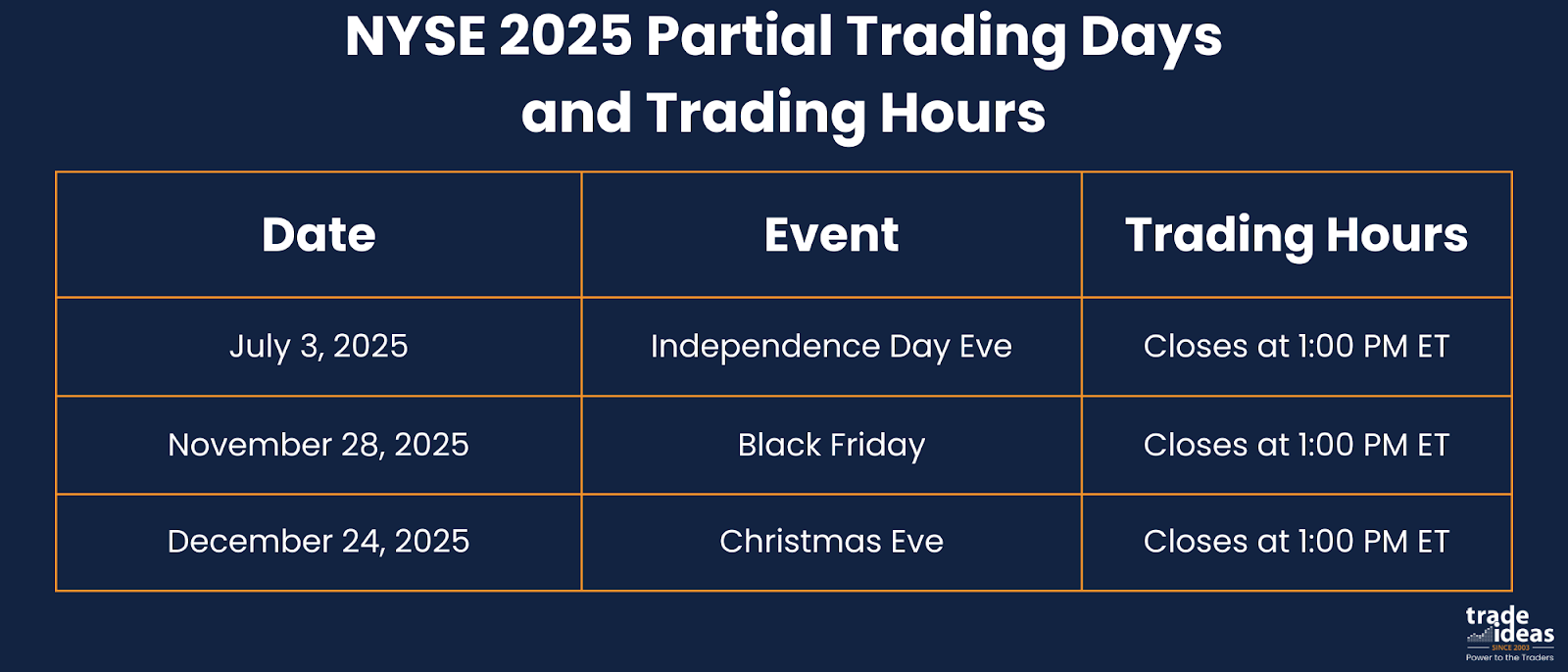
This analysis is based on the MarketWatch report [6] and supporting data from the Ginlix Analytical Database and other sources. For Christmas Eve 2025, the U.S. stock markets (NYSE and Nasdaq) closed early at 1:00 p.m. ET, with eligible options closing at 1:15 p.m. ET. Bond markets also closed early at 2:00 p.m. ET, and both markets were closed on Christmas Day (Dec 25), reopening for regular sessions on Dec 26 [1][2][3][4]. Mid-morning trading (10:24 ET) showed mixed performance: the Dow Jones Industrial Average was up 0.29% at $48580.76, S&P 500 up 0.10% at $6916.92, and Nasdaq Composite down 0.07% at $23545.11 [0]. Trading volume for all indices was far below 50-day averages: Dow (73.19M vs. 562.51M avg), S&P 500 (293.38M vs. 5.37B avg), Nasdaq (1.51B vs. 9.48B avg) [0]. This low liquidity is typical for holiday-shortened sessions, increasing the risk of amplified price movements from small order flows [2]. Broader market sentiment remained driven by economic factors (upbeat U.S. growth, sticky inflation, Fed rate cut expectations) rather than the holiday closure [2]. Indirectly, global markets with U.S. exposure, such as Hong Kong’s Hang Seng Index, also had a half-day session on Dec 24 [5].
- Holiday Schedule Doesn’t Alter Long-Term Trends: The shortened session did not trigger significant medium-term market shifts; underlying economic conditions continued to be the primary drivers of sentiment [2].
- Global Market Interconnectedness: Hong Kong’s half-day session alongside U.S. early closures highlights coordinated holiday adjustments across major global financial markets.
- Historical Context vs. Current Risks: While historical data suggests pre-Christmas markets tend to be less volatile, the extreme low liquidity in this session created potential exceptions to this trend.
- Risks:
- Low Liquidity Risk: Reduced trading volume could lead to wider bid-ask spreads and exaggerated price movements, posing risks for traders [2].
- Limited Access Risk: Investors with time-sensitive trading needs may face constraints due to the early closure and subsequent full-day shutdown [1][2].
- Opportunities:
- Reduced Volatility Potential: Historical trends indicate pre-Christmas sessions often have lower volatility, though this is counterbalanced by the liquidity risk in this year’s session.
This analysis consolidates details on the 2025 Christmas Eve holiday market schedule, early closures for U.S. stocks (1:00 p.m. ET), bonds (2:00 p.m. ET), and mixed mid-morning performance with drastically reduced volume. Low liquidity is the primary short-term concern, while broader economic factors remain the main long-term market drivers. No specific investment recommendations are provided.
Insights are generated using AI models and historical data for informational purposes only. They do not constitute investment advice or recommendations. Past performance is not indicative of future results.
About us: Ginlix AI is the AI Investment Copilot powered by real data, bridging advanced AI with professional financial databases to provide verifiable, truth-based answers. Please use the chat box below to ask any financial question.