
China Tech Rally vs Economic Struggle: Market Analysis November 7, 2025
Unlock More Features
Login to access AI-powered analysis, deep research reports and more advanced features
About us: Ginlix AI is the AI Investment Copilot powered by real data, bridging advanced AI with professional financial databases to provide verifiable, truth-based answers. Please use the chat box below to ask any financial question.
Related Stocks
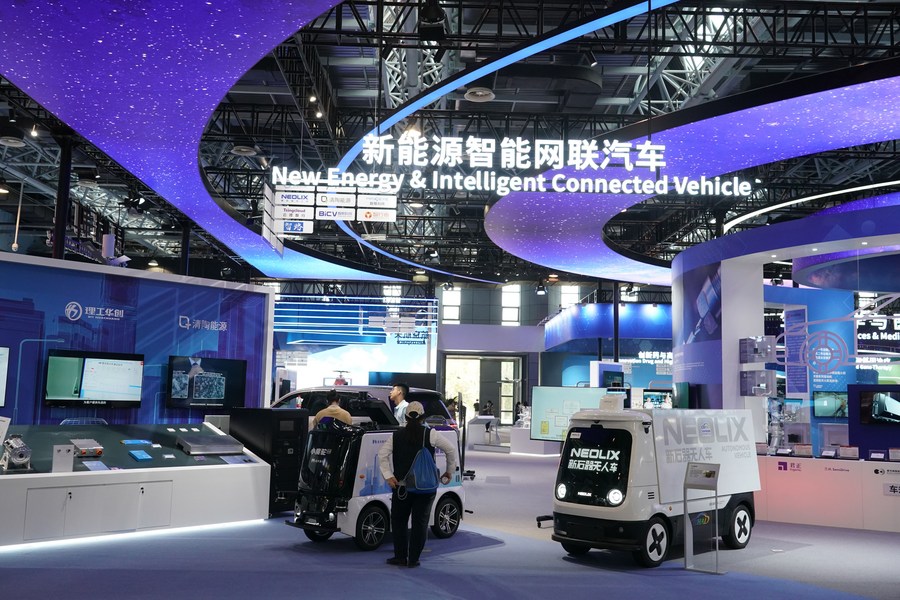
This analysis is based on the Barron’s report [1] published on November 7, 2025, highlighting China’s dual challenge of technological advancement versus economic weakness. Chinese tech stocks have dramatically outperformed global markets in 2025, gaining 41% compared to the Nasdaq’s 17% increase [2]. However, this rally occurs against a backdrop of struggling domestic consumption and broader economic malaise, creating a significant disconnect between sector-specific optimism and macroeconomic fundamentals.
The stark contrast between China’s tech sector performance and broader economic health represents the central theme of current market dynamics. While the Hang Seng Tech Index has shown remarkable strength, marking a reversal from Beijing’s previous crackdown on the sector [2], the CSI 300 index has demonstrated flat returns on equity for four consecutive quarters [2]. This divergence suggests that market participants are betting heavily on China’s technological future despite current economic challenges.
U.S. markets are experiencing their own tech-related pressures, with yesterday’s session seeing significant declines across major technology names including Nvidia, AMD, Palantir Technologies, and Microsoft [1]. The technology sector emerged as the worst performer in pre-market trading at -1.31% [0], indicating persistent valuation concerns that are affecting both Chinese and U.S. tech stocks, albeit through different mechanisms.
China’s economic struggles center on weak domestic demand, which remains insufficient to drive sustainable growth despite government efforts to stimulate consumption [1]. The deflationary environment continues to pressure corporate earnings and consumer spending, creating a challenging backdrop for broad-based economic recovery. However, Beijing’s commitment to innovation and technological advancement has created a powerful narrative that is driving investor enthusiasm for Chinese tech stocks [1].
This dynamic reflects a broader global trend where technology sectors are increasingly decoupled from traditional economic indicators. The surge in Chinese tech stocks appears to be driven by:
- Government policy support for innovation and AI development
- Investor belief in China’s long-term technological capabilities
- Relative value compared to U.S. tech valuations
- Speculative momentum in the sector
European stocks have opened higher as investors ease concerns about tech valuations, with the Bank of England signaling potential rate cuts in December [1]. Asian markets traded lower overnight, contributing to cautious global sentiment [1]. The U.S. 10-year Treasury yield hovering near 4.10% continues to pressure high-growth technology stocks globally [1].
The most significant insight is the growing structural disconnect between China’s tech sector performance and its broader economy. This suggests that:
- Market participants are pricing in a longer-term technological transformation
- Current economic weakness may be viewed as temporary in the context of China’s innovation push
- The traditional relationship between economic growth and equity market performance may be evolving
Beijing’s strategic pivot toward technology and innovation represents a fundamental shift in economic policy that is creating new investment opportunities while masking underlying economic weaknesses. The government’s commitment to supporting the tech sector appears to be overriding concerns about short-term economic performance [1].
The simultaneous tech valuation concerns in both Chinese and U.S. markets indicate a global reassessment of technology sector valuations. While Chinese tech stocks have outperformed, they are not immune to the broader concerns about high-growth valuations in a rising rate environment.
- Economic-Performance Disconnect: The widening gap between tech sector optimism and economic fundamentals creates significant downside risk if economic weakness persists
- Policy Reversal Risk: Beijing’s current tech-friendly stance could reverse if economic conditions deteriorate further
- Global Tech Valuation Correction: Continued pressure on tech valuations globally could affect Chinese tech stocks despite their relative outperformance
- Consumer Demand Weakness: Without improvement in domestic consumption, economic growth may remain constrained
- Relative Value: Chinese tech stocks may offer relative value compared to U.S. counterparts if current momentum continues
- Policy Support: Continued government backing for innovation could drive sustained sector growth
- Long-Term Transformation: China’s commitment to technological advancement could create significant long-term value despite near-term economic challenges
- Chinese tech stocks: +41% in 2025 [2]
- Nasdaq Composite: +17% in 2025 [2]
- CSI 300: Flat returns for four consecutive quarters [2]
- U.S. tech sector pre-market: -1.31% [0]
- China faces ongoing deflationary pressure and weak domestic demand [1]
- U.S. 10-year Treasury yield: ~4.10% [1]
- Key employment data due today at 8:30 AM ET [1]
- S&P 500: Support at 6,631, resistance at 6,796 [0]
- Nasdaq: Support at 22,563, resistance at 23,636 [0]
- 10-Year Treasury Yield: Key level at 4.10% [1]
The analysis reveals a complex market environment where China’s technological ambitions are creating significant investment opportunities while masking underlying economic challenges. The sustainability of this divergence will depend on Beijing’s ability to translate innovation policy into broader economic recovery and improved domestic consumption.
Insights are generated using AI models and historical data for informational purposes only. They do not constitute investment advice or recommendations. Past performance is not indicative of future results.
About us: Ginlix AI is the AI Investment Copilot powered by real data, bridging advanced AI with professional financial databases to provide verifiable, truth-based answers. Please use the chat box below to ask any financial question.