
Supreme Court Tariff Authority Hearing: Market Impact and Strategic Implications
Unlock More Features
Login to access AI-powered analysis, deep research reports and more advanced features
About us: Ginlix AI is the AI Investment Copilot powered by real data, bridging advanced AI with professional financial databases to provide verifiable, truth-based answers. Please use the chat box below to ask any financial question.
Related Stocks
This analysis is based on the Invezz report [1] published on November 7, 2025, which examined market positioning following the Supreme Court’s skeptical hearing on Trump’s tariff authority.
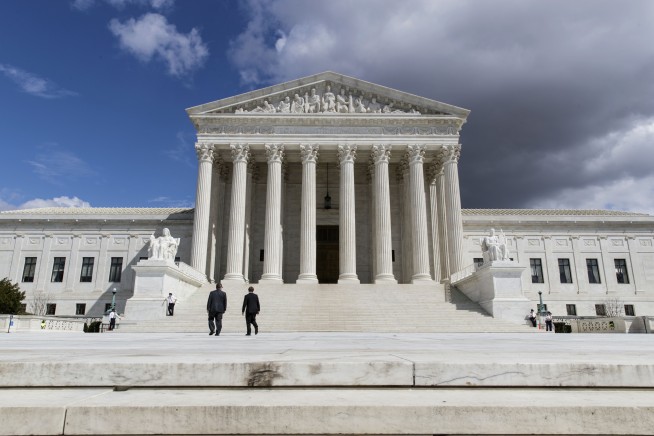
The Supreme Court’s oral arguments on November 5, 2025, challenging President Trump’s authority to impose broad tariffs under the 1977 International Emergency Economic Powers Act (IEEPA) generated immediate and sophisticated market reactions [1]. The court’s skeptical questioning, particularly from conservative justices including Chief Justice John Roberts, signaled that broad emergency tariffs may not survive legal scrutiny [1].
- Dow Jones Industrial Average gained 225 points (+0.4%) [0]
- S&P 500 increased 0.3% [0]
- Nasdaq Composite rose 0.6% [0]
- Russell 2000 outperformed with a 1.47% gain [0]
- 10-year Treasury yield climbed 6.4 basis points to 4.155% [2]
- This yield increase indicates a rotation from safe-haven assets to equities, reflecting reduced tariff uncertainty [2]
- Healthcare (+0.45%) and Real Estate (+0.09%) showed resilience [0]
- Technology (-1.58%), Industrials (-2.28%), and Consumer Cyclical (-2.13%) sectors underperformed [0]
- Walmart (WMT) gained 0.21% to $101.68, benefiting from potential tariff rollback reducing procurement costs [0]
- Target (TGT) declined 3.03% to $89.15, underperforming despite tariff optimism, suggesting company-specific factors [0]
- General Motors (GM) edged up 0.10% to $68.84, with each automaker having absorbed over $1 billion in tariff expenses since February [0]
- Ford (F) gained 0.08% to $13.12, showing similar modest gains on potential margin recovery [0]
The market’s reaction reflects sophisticated hedging rather than pure optimism. Treasury yields increased rather than plummeting, indicating that sophisticated traders expect the administration to pivot toward alternative tariff authorities [1]. The Trump administration has signaled it would use Section 122 of the Trade Act or Section 338 of the Tariff Act if IEEPA is struck down [1].
- If the Supreme Court compels tariff refunds, it could impact $89 billion in IEEPA tariffs and worsen the federal budget deficit [1]
- This fiscal pressure could lead to higher Treasury yields across the economy [2]
The Supreme Court won’t rule until the term’s end, likely June 2026, creating a six-month window of acute uncertainty that businesses must navigate [1]. Prediction markets show only a 25% chance that Trump’s tariffs will hold, down from roughly 50% before the hearing [2].
-
Policy Continuity Through Alternative Frameworks:Even a narrow ruling against IEEPA won’t eliminate tariffs, merely change their legal foundation [1]. The administration’s preparedness to use alternative authorities suggests policy continuity despite legal challenges.
-
Corporate Treasury Strategic Planning:Corporate treasury teams are quantifying total IEEPA tariff spend since February to model refund eligibility [1]. Importers are preparing dual scenarios: executing refund strategies while positioning for tariff persistence [1].
-
Market Sophistication in Risk Pricing:The simultaneous equity rally and Treasury yield increase demonstrates that markets are pricing in both short-term relief from uncertainty and long-term fiscal implications of potential tariff refunds [1][2].
The divergent sector performance reveals nuanced market expectations. Technology and industrial sectors, which are more directly exposed to supply chain disruptions and international trade, underperformed despite overall market optimism [0]. This suggests investors anticipate continued trade policy uncertainty regardless of the Supreme Court’s specific ruling.
-
Extended Policy Uncertainty:The timeline to June 2026 creates prolonged uncertainty that could trigger market volatility [1]. Even a favorable ruling won’t eliminate tariffs, potentially extending business planning challenges.
-
Fiscal Pressure and Interest Rate Impact:Tariff refunds could increase government debt, potentially leading to higher interest rates across the economy [2]. This fiscal pressure may offset some corporate benefits from tariff reduction.
-
Supply Chain Disruption Continuation:Extended uncertainty may continue to complicate procurement and pricing strategies for businesses heavily reliant on international supply chains [1].
-
Corporate Treasury Optimization:Companies with significant IEEPA tariff exposure since February 2025 may benefit from strategic refund planning and documentation [1].
-
Sector Rotation Potential:The current sector divergence may present opportunities for strategic positioning, particularly in sectors that have underperformed despite overall market optimism [0].
-
Risk Management Solutions:The extended uncertainty window through mid-2026 creates demand for sophisticated hedging and risk management strategies [1].
The Supreme Court’s November 5, 2025 hearing on Trump’s tariff authority has created a complex market environment characterized by sophisticated risk pricing and strategic positioning. While equity markets responded positively to reduced uncertainty, the simultaneous rise in Treasury yields reflects concerns about fiscal implications and the likelihood of policy continuity through alternative legal frameworks [1][2].
The extended timeline to the Court’s June 2026 ruling creates a prolonged period of uncertainty that businesses must navigate through dual scenario planning [1]. Corporate treasury teams are actively quantifying IEEPA tariff exposure for potential refund eligibility while preparing for tariff persistence under alternative legal authorities [1].
Prediction markets indicate a significant shift in expectations, with the probability of Trump’s tariffs surviving dropping from 50% to 25% following the Court’s skeptical questioning [2]. However, the administration’s signaled readiness to pivot to Section 122 of the Trade Act or Section 338 of the Tariff Act suggests that trade policy uncertainty may persist regardless of the specific ruling [1].
Market participants should monitor Supreme Court deliberations, Treasury Department guidance on alternative tariff authority implementation, corporate disclosures about tariff exposure, and international trade partners’ responses to various ruling scenarios throughout the extended uncertainty period [1].
Insights are generated using AI models and historical data for informational purposes only. They do not constitute investment advice or recommendations. Past performance is not indicative of future results.
About us: Ginlix AI is the AI Investment Copilot powered by real data, bridging advanced AI with professional financial databases to provide verifiable, truth-based answers. Please use the chat box below to ask any financial question.